Showing posts with label UP polls 2017. Show all posts

Tuesday, 14 March 2017

How Akhilesh Yadav and Mayawati's mistakes helped Modi win UP polls

Modi

ELECTION NEWS - There is more to Prime Minister Narendra Modi’s mind-boggling sweep in the Uttar Pradesh assembly elections than can be explained by factors like his persona, Modi’s aggressive, high profile campaign in the state, the caste configuration of the state or for that matter, the communal turn of his campaign.

Perhaps, the win is also a consequence of the sustained attacks that the Akhilesh Yadav-Rahul Gandhi duo and BSP supremo Mayawati launched against some of Modi’s policies.

Gandhi’s outburst against the army’s surgical strikes on terror camps along the Line of Control – which he termed as “khoon ki dalaali” – went against the nationalist sentiments of even those who do not subscribe to the saffron ideology. In one stroke, Gandhi lost much of the steam he’d generated through his aggressive efforts to rejuvenate the Congress in UP.

However, it was Gandhi, Yadav and Mayawati’s tirade against demonetisation that served as an even bigger boon for Modi.

Without making any effort to see the ground reality, these leaders went on a Modi bashing spree – that evidently proved counter-productive and paid Modi dividends that surprised him as much as those who voted for him.(READ MORE)

Friday, 10 March 2017

2017 polls: 'Modi wave' is alive and kicking

Modi

UP ELECTION RESULT 2017 - With gruelling elections in five states, including Uttar Pradesh, now over, the popular discourse has now shifted to predicting the poll results, which anyhow would be out in the open tomorrow.

While most exit polls have accorded the edge in poll outcome to the Bharatiya Janata Party (BJP), barring Punjab, the results nonetheless would be analysed in the context of Prime Minister Narendra Modi.

BJP’s biggest mass leader to date, Modi had crisscrossed the poll-bound states of UP, Uttarakhand, Punjab, Goa and Manipur, over the last two months to consolidate the party’s core votes. However, he had invested maximum energies in the crucial state of UP, which returns 403 legislators to the state assembly.

Although Modi was not a candidate himself, the polls were largely played on the theme of ‘Modi versus all’ in all these states, especially UP.

In the backdrop of demonetisation, the polls are being seen as virtual referendum on Modi’s three-year rule at the Centre and the impact of the demonetisation decision.

BJP has swept all the local bodies polls held across the states after demonetisation, which implied that the majority of people had stood up for the purported anti-corruption move and that the perception of Modi’s personal integrity was uncompromised.(READ MORE)

Mayawati chides 'babua' Akhilesh for 'childish talk' on jumbo statues

Bahujan Samaj Party Chief Mayawati. Photo: PTI

UP ELECTION RESULT 2017 - BSP chief Mayawati on Thursday took a swipe at Uttar Pradesh Chief Minister Akhilesh Yadav for his continued attack on the elephant statues set up by her government, saying he was indulging in "childish talk".

"Just as Mulayam Singh Yadav (a former defence minister) speaks of China at any given opportunity, his 'babua' (child), Akhilesh, has nothing to tell people except for patharwali sarkar," Mayawati told a press conference here.

"Everyone knows that the stone statue of elephant will remain in the same position...This is why I call him babua, as only a babua can say something like this. He is indulging in childish talk," Mayawati asserted.

"Even a small kid will be able to tell this. He (Akhilesh) is the father of kids and yet talking like this," she said.

Mayawati said people wanted to question the SP government on issues of "mafiaraj, gundaraj, jungleraj and anarchy" but instead he wanted to indulge in politics of stone.

She, however, thanked the "babua" for talking about the elephants as he was giving free publicity to her party's election symbol.

Mayawati also raked up SP patron Mulayam Singh Yadav's invite to Modi and other BJP leaders to attend a family wedding function in Saifai, and alleged that SP and BJP had a tacit understanding.(READ MORE)

Assembly Elections 2017 LIVE: SP-Cong, BSP, AAP Reject Exit Poll Verdict

Exit Polls 2017: Advantage BJP in UP but Modi may fall short of majority

Narendra Modi

UP ELECTION RESULT 2017 - Prime Minister Narendra Modi's party is well ahead of rivals in an election in the country's most populous state, Uttar Pradesh, but may fall short of an absolute majority, four major exit polls showed on Thursday.

Victory for Modi's Bharatiya Janata Party (BJP) in Uttar Pradesh, which is home to 220 million people, would boost his chances of winning the 2019 general election and underscore his popularity after he made himself the face of the party's campaign.

The prime minister would also see success as vindication of his sudden decision in November to abolish high-denomination banknotes to rein in corruption.


The move was seen as politically risky, because most transactions in India are carried out in cash and millions of Indians were forced to join long queues outside banks to deposit their old bills or get hold of new ones.

Indian elections are notoriously hard to call, and polls taken before and after voting are often wrong. Pollsters were left red-faced in 2015 after mistakenly predicting a BJP win in the state of Bihar.

Results in Uttar Pradesh, as well as four other state ballots, will be announced on Saturday.(READ MORE)

Exit Polls 2017 LIVE: Market Sees UP Results As Litmus Test For BJP

Exit polls predict BJP win in UP, but Dalal St euphoria to fade away soon

UP assembly polls, Children, BJP flags, BJP, Narendra Modi, roadshow, Varanasi, Uttar Pradesh

UP ELECTION 2017 RESULT - Exit polls have predicted a victory for the Bharatiya Janata Party (BJP) in the key state of Uttar Pradesh (UP) that is being dubbed as the semi–final to the 2019 general elections, and appeared to be too close to call.

Over the past few sessions, the markets have been moving sideways, consolidating the 9% gain made thus far in calendar year 2017. Analysts say the outcome could create distractions (or positives) for the government and will be interpreted as a referendum on the government’s demonetisation drive.

Here is a quick compilation of what the leading market experts think about the possible outcome and its implication for the economy and markets:

G. CHOKKALINGAM, FOUNDER & MANAGING DIRECTOR OF EQUINOMICS RESEARCH & ADVISORY

The exit polls have predicted significant improvement for the ruling party at the Centre. If this prediction becomes true, it could be sentimentally positive for the equity markets for a week or so. However, in our view, fundamentally speaking, whether the ruling party wins or loses, it doesn’t have significant relevance for the markets.(READ MORE)

Exit Polls 2017 LIVE: Sensex Sees UP Results As Litmus Test For BJP

Assembly polls 2017: 12 reasons why fight in UP is between the BSP and BJP

Narendra Modi, up elections

UP ELECTION RESULT 2017 - Now that all the phases are of the Uttar Pradesh elections are over, the time has come for predictions. Several senior journalists, in my opinion, misused their influence by calling the election before the final phase of voting.

The observations I present here are based on travels in the state, evolving trends over the past three years (particularly in west UP) and conversations with a wide range of people (in person and over the phone). Let me start by presenting five reasons why UP is most probably headed towards a hung assembly.

This was not a ‘wave’ election. In the initial phases, the media tried to project an Akhilesh Yadav wave, in the latter phases, a Narendra Modi wave. But there was no ‘wave’ on the ground. Truth is, this was a seat to seat election and individual candidates, localised caste arithmetic and issues will determine the result.

National issues like demonetisation will have an indirect impact. While not many may have voted directly on that issue, for castes like Jats and sections of non-Jatav Dalits who may have voted the BJP in 2014 and were already drifting away from the party for various reasons, demonetisation was the final nail in the coffin, leading to them snapping their ties or loyalty for the party. One is very uncertain about Banias, though. Many Banias, who are among the most loyal BJP voters, were very upset with demonetisation. However, whether that has resulted in voting elsewhere and to what extent is unclear. The community has been very silent this time. And in many parts, they didn’t even openly campaign for the BJP.(READ MORE)

Exit Polls 2017 LIVE: Advantage BJP In UP, Akhilesh-Rahul Fail To Impress

Tuesday, 7 March 2017

Uttar Pradesh is the BJP's to lose. Or is it?

BJP, Narendra Modi, UP election 2017,

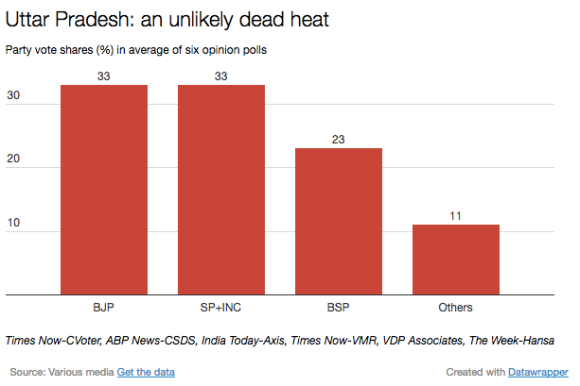
UP POLLS 2017 - As counting day on 11 March approaches, it seems as difficult as ever to gauge which way the political wind in Uttar Pradesh (UP) is blowing. Even before the campaign began, pre-election opinion polls offered little help, showing the Bharatiya Janata Party (BJP) and the Samajwadi Party (SP)-Congress alliance neck and neck, with the Bahujan Samajwadi Party (BSP) lagging.
Screen Shot 2017-03-06 at 6.32.02 PM.png

We know from elections in Delhi (2015), Bihar (2015) and West Bengal (2016) that a dead heat in pre-election polls is almost never a good predictor of the eventual outcome.

So what are the BJP’s chances of pulling off a win? If the starting point is the BJP’s historic 2014 victory, its lead seems unassailable. The BJP won 328 of 403 assembly segments, including 253 with more than 40% of the vote, and as Praveen Chakravarty states, for it to win fewer than 200 seats even if “two of the opposition parties get together, the BJP would still have to lose more than 10% of its voters”.(READ MORE)

Monday, 6 March 2017

Is Modi's presence in Varanasi a sign of BJP's desperation to win UP polls?

Up assembly polls, Women, queue, Amethi, fifth phase, Assembly elections, Uttar Pradesh

UP Assembly Elections 2017 - Till the third phase of the UP assembly elections, the BJP had a relatively quiet campaign, but it seems to have changed its tactic mid-way through the fourth phase, making excessive use of the prime minister.

Varanasi: For the last three days, the political capital of the country seems to have shifted to Varanasi. Yesterday, it witnessed the rally of an ex-chief minister, a road show of the current chief minister with the vice president of the main opposition party, and a ‘de-facto road show’ of the prime minister – all in a single day. As residents breathe a sigh of relief after yesterday’s historic road jam, their problems are not likely to ease till March 6, the day when the campaign for the last phase of the UP elections comes to an end.

Most hotels are fully booked and scores of OB vans are stationed in Varanasi as journalists from Delhi and UP remain camped in the city, along with a number of star campaigners, officials and security personnel. There is a camera in every other tea-kachori shop, clichéd talk shows in boats on the Ganga or at Assighat have flooded television screens, and ‘local experts’, popularly called ganmany naagrik, are overworked as journalists run out of ideas to do stories on. In this scenario, a surprising development is the sudden increase in rallies and the presence of Prime Minister Modi in Uttar Pradesh.(READ MORE)

Wednesday, 1 March 2017

150 seats in UP, AIADMK support crucial for Modi govt to win prez polls

Modi

UP POLLS 2017 - Currently, the Bharatiya Janata Party (BJP) has nearly 3.80 lakh votes in the presidential electoral college. To reach the halfway mark of 5.49 lakh votes, the party needs another 1.7 lakh votes. The over 1 lakh votes of its alliance partners, both at the Centre and in states, reduces this gap to around 70,000 votes. This is where the Uttar Pradesh assembly, with its 403 seats and a total value 83,824 votes to the presidential electoral college, is important.

The President of India is elected by the members of an electoral college that comprises the elected members of Lok Sabha and Rajya Sabha and elected members of all legislative assemblies, including Delhi and Puducherry. Nominated members, whether of Parliament or legislative assemblies, are not included.

Value of vote for each of the members of the electoral college is decided based on the population census of 1971. Therefore, value of votes differs from state to state. The value of the vote of a legislator from Uttar Pradesh, the state with the largest population, is the highest at 208, while Sikkim’s is the lowest at 7.

The Modi government would hope to meet this shortfall of 70,000 votes by winning as many seats as possible in Uttar Pradesh. It would also need to compensate from UP the likely losses that the BJP and ally Shiromani Akali Dal could suffer in Punjab. A good showing in Uttar Pradesh would also deflate the Opposition and help Modi government strategists persuade fence sitters among the regional parties to vote for the ruling coalition's candidate.(READ MORE)

Monday, 27 February 2017

War rooms and UP polls 2017: Akhilesh Yadav takes on Modi at his own game

akhilesh, yadav, BSP, election, UP

UP Polls 2017 - Prime Minister Narendra Modi out-campaigned all-comers in the 2014 general election but, as he faces his biggest mid-term test, he is up against a rival determined to beat him at his own game.

In Uttar Pradesh his opponent, Chief Minister Akhilesh Yadav, has been repackaged as a youthful and media-savvy go-getter who seeks to steal a unique selling point of Modi's - development.

"I am taking it a bit beyond Modi: I work," Yadav told Reuters in an interview in Lucknow, capital of the state of 220 million that is holding the biggest democratic election anywhere in the world this year.

"My work speaks for itself. Modi's empty promises do not," said the 43-year-old leader of the Samajwadi, or Socialist, Party.

Yadav entered the vast election, being held over the course of a month, as a narrow favourite: He had just emerged from a power struggle with his domineering father and struck a pre-poll alliance with the Indian National Congress.(Read More)

Thursday, 23 February 2017

UP elections 2017: Over 40% turnout till 2 PM in phase-IV

UP polling

UP Polls 2017 - Over 40 per cent of 1.84 crore voters exercised their franchise till midday today in the fourth phase of polling in eastern Uttar Pradesh.

"Polling is underway at a brisk pace in 53 assembly constituencies spread over 12 districts, including the backward Bundelkhand region," the CEO office said here.

The pace of voting was slow in the first few hours but picked up as the day advanced.

The exercise was by and large peaceful in view of tight security arrangements.

Inter district and inter state borders have been sealed and patrolling by security forces has been intensified in poll-bound areas. Most of the sensitive polling centres are being manned by the personnel of Central Paramilitary Forces.

680 candidates are in the fray in this phase which covers Rae Bareli, Pratapgarh, Kaushambi, Allahabad, Jalaun, Jhansi, Lalitpur, Mahoba, Banda, Hamirpur, Chitrakoot and Fatehpur districts.

The BSP has fielded its nominees in all seats, while BJP's nominees are in 48 constituencies. The BJP has left 6 seats for its ally Apna Dal. The SP nominees are in contest in 30 segments and its ally, the Congress, is in contest from 25 constituencies.(Read More)

Wednesday, 22 February 2017

UP polls 2017: BSP has an edge and Mayawati is likely to return to power

BSP Chief Mayawati. Photo: PTI

UP Polls 2017 - Six months prior to the 2017 Assembly elections, the battle for power in Uttar Pradesh was seen as a fight between the Bahujan Samaj Party (BSP) led by Mayawati and the Bhartiya Janata Party (BJP), which is presently ruling at the centre. The BJP's chances had dwindled slightly after its state vice president Dayashankar Singh made some inappropriate comments against Mayawati. At that point, the Samajwadi Party, the party currently in power, was widely perceived to be out of the race.

All of a sudden, a series of melodramatic incidents within the SP's ruling family catapulted Akhilesh Yadav from the status of 'half CM' to full chief minister and leader of the party. Earlier, he was often taunted to be subordinate to the SP's big four: his father Mulayam Singh Yadav, uncle Shivpal Yadav, uncle Ram Gopal Yadav and senior leader Azam Khan. The impression formed that since Mulayam was publicly taking the side of his brother Shivpal, party cadres would remain loyal to Shivpal if it came to choosing between him and Akhilesh. However, Akhilesh proved everybody wrong and now is the undisputed claimant to the chief ministership on behalf of the Samajwadi Party, with Shivpal and even Mulayam having been marginalised. The state witnessed a silent coup by a serving ruler who has been able to unshackle himself now.(Read more)

Monday, 20 February 2017

UP elections 2017: Poll promises have not changed in 15 years; here's why

Voters, queue, vote, second phase, UP assembly polls, Moradabad

UP Elections 2017 - Pihani, Uttar Pradesh: For 16 years, Kailash Rai (not his real name), 49, has been commuting six hours every working day between his home in the state capital Lucknow and the government degree college where he teaches in Pihani, 135 km to the northwest.

A political-science lecturer, Rai cannot move with his family to Pihani, a cluster of over 100 villages (called a kasba) in Hardoi district, with less than 40,000 families as per Census 2011. When he started working there in 2000, it lacked the basic public facilities–regular power supply, good roads, public transport and good medical services.

Pihani remains an economic backwater. In the ongoing assembly elections, UP’s incumbent and contesting politicians are still promising the basic facilities they did 16 years ago: Electricity, buses and jobs, along with laptops and free data for poor youth.

A UP kasba: 100% rural, 83% farm workers
A community development block in Hardoi district, north-west of Lucknow, Pihani is an agglomeration of over 100 small villages. This rural administrative division is called a taluk or tehsil in other states. UP has 901 such blocks administered by a block development officer.
pihani
A third of Pihani’s population consists of people belonging to scheduled castes and tribes. Its literacy rate is 51%, and less than half its women (41%) are literate. Women in Pihani form about 14% of the workforce, nine percentage points less than the national average of 27% as IndiaSpend reported in April 2016.(Read More)

Friday, 17 February 2017

UP polls 2017: SP-Cong alliance pins hope on note ban anger to fight BJP

Akhilesh Yadav, Rahul Gandhi, UP

Campaigning comes to an end for the third phase of Uttar Pradesh assembly elections 2017 today evening. As many as 69 seats across central UP’s Lucknow, Kanpur, Sitapur, Mainpuri, Etawah and adjoining districts will vote on Sunday. Samajwadi Party and Congress workers in the region are nervous. They fear a Hindu consolidation for Bharatiya Janata Party (BJP). The BJP believes the third phase will mark a revival of the party after a tepid response in the first two phases.

In the cities and towns of central UP, there is a positive buzz for Chief Minister Akhilesh Yadav but the alliance’s hopes rest more on the mistakes of its rival. The alliance has tried to tap into the anger on the street for Narendra Modi government’s note ban decision, the perceived non-performance of BJP’s Lok Sabha members of Parliament and the infighting in that party’s ranks because of faulty ticket distribution.

But the cadres are also discovering a groundswell of support from the upper castes who wish deliverance from the “Ahir-Muslim” rule of the last five years. The BJP is sure that the patchwork of caste coalition of upper castes and non-Yadav OBCs would help it win majority of the seats in the region.
1. Hindu consolidation
2. Note ban
3. Non-performance of BJP MPs, poor candidate selection
4. Chinks in SP-Congress alliance
5. Anti-incumbency and law and order
6. Split in Muslim votes

Friday, 10 February 2017

UP polls 2017: Maya's fortunes hinge on winning reserved seats from SP, BJP

Mayawati

UP elections 2017 - In many ways, Uttar Pradesh  2017 is not just a survival game for the Bahujan Samaj Party (BSP) but also a matter of pride for party matriarch Mayawati. An indicator of whether Mayawati will become the next chief minister (CM) of UP depends on whether she can win in most of the 55 new reserved constituencies created after the delimitation exercise in the state in 2008. Before delimitation in 2008, UP had 89 reserved constituencies. Now there are 85. Furthermore, in the 30 constituencies that continued to be reserved post 2008, Mayawati would have to make big strides to reclaim the ground she ceded to the Samajwadi Party (SP) and Bharatiya Janata Party (BJP).

That may be hard, but not impossible. The BSP has not been able to recover from the effects of the 2008 delimitation exercise that not just reduced the number of reserved constituencies by four, but also made the new ones less concentrated with Dalits who form the party’s core voter base.

In 2012 assembly elections, in the 55 new reserved constituencies, the BSP managed to win just 11. Mayawati’s biggest challenge will be to uproot the SP from these new reserved constituencies. To do so, she may have to win most of 30 seats which the SP won in 2012 in the newly-created reserved assembly constituencies. What makes her job harder is that before she could make a mark on these newly-reserved constituencies, the BJP had already made rapid inroads into them.(Read More)

Win at all costs? PM Modi's reforms meet realpolitik in Uttar Pradesh polls

Narendra Modi, Modi, PM

Elections 2017 - Prime Minister Narendra Modi has promised to clean up politics. The man running the ruling party's campaign in a crucial state election, who is facing 11 criminal cases, says it will take a while.

"At a time of elections, one has to forget every other aspect and just focus on victory," said Keshav Prasad Maurya, as his three-vehicle convoy carrying police with automatic rifles sped through the countryside.

Polls open on Saturday in Uttar Pradesh, with a population of some 220 million, and on the ground Modi's loftier aims for a new India seem far away.

Maurya, the state's president for the ruling Bharatiya Janata Party (BJP), says the charges against him are false and politically motivated; unless he is convicted, they do not prevent him from holding office.

His bosses are not concerned.

An official at the prime minister's office referred questions about Maurya and his criminal cases to the BJP, where an aide to party president and Modi confidant Amit Shah said there was no problem.(Read More)

Down under, ‘King’ Kohli is thunder: Why Aussies are going gaga over Virat

The Indian skipper’s exploits apart, the broadcasters may have little choice: With local stars Smith and Warner banned, they might grab so...